Translate

Showing posts with label D. Main Courses. Show all posts

Saturday, December 7, 2013

Meat-Filled Vegetables (Delicious Dolma) - The Quintisential VB6 Dinner

Dolma means "stuffed" in Turkish, and I think this meal of stuffed vegetables is a quintisential VB6 dinner.  It is a vegetable-dominated dish that features a small amount of meat, some rice, and plenty of herbs.  Topped with garlic infused yogurt, dolma is a healthy, well-balanced, easy-to-prepare and very delicious non-vegan meal that represents the perfect compromise for the part-time vegan who is carefully watching his or her meat consumption.

I start with 1 lb. of high quality organic ground beef.  You can also use lamb, or a combination of beef and lamb.  To that, I add 1grated white onion, 1 grated juicy red tomato, a cup each of well-chopped fresh dill, mint, and Italian flat leaf parsley, 1/3 cup of uncooked long-grain rice, 1 clove of garlic (finely minced), and some salt and black pepper.  Combine.

For the vegetables, you will want about 15 of of your favorite in-season stuffable vegetables.  The most common choices are small, thinner skinned bell peppers, slender eggplants, such as Japanese eggplants, zucchinis, tomatoes, and stuffable leaves, such as cabbage and grape leaves.  Today I chose Japanese eggplants, round zucchinis (one of my favorite dolma vegetables), red and green bell peppers, poblano chiles (definitely not a traditional choice, but really delicious in dolma), and tomatoes.


I prepare the vegetables for stuffing by cleaning them and carefully removing (and reserving) all the tops.  I remove and toss the pepper seeds and membranes.  Next, I hollow out the eggplants, zucchinis, and tomatoes with my nifty vegetable corer, reserving all of the removed pulp to line the bottom of my cooking pot.  I also partially peel the eggplant, leaving long zebra stripes (pictured below).


Then I stuff all my vegetables.  And if I find I have any leftover stuffing, I just dig out another vegetable or two from the refrigerator.


Once all the vegetables are stuffed, I pull out a really big pot and line the bottom of it with all the pulp that I removed from the eggplants, zucchinis, and tomatoes.  Then I start layering the pot with the stuffed vegetables -- the firmest and heaviest vegetables go on the bottom, and the lightest and most delicate vegetables go on top.  I then add several pats of butter and about 2-3 cups of hot water mixed with 2 tablespoons of tomato paste.  Next, I sprinkle in about 1/2 teaspoon salt and place an ovenproof plate on top to weigh down the vegetables.  Finally, I bring the liquid to a boil, and cover and cook on a low heat until the meat is cooked through and the vegetables are tender, but not mushy.  It should take about a hour, but start checking for doneness after 45 minutes.


We love our dolma served with cooked bulgur on the side, and topped with a generous portion of creamy plain yogurt mixed with fresh minced garlic.  And a sprinkling of Turkish red pepper (pul biber) sets it off perfectly!


Wednesday, October 30, 2013

Jerusalem, a Cookbook: Turkey & Zucchini Meatballs...

My favorite new reading companion, Jerusalem, by Yotam Ottolenghi and Sami Tamimi, has some of the most intriguing, flavorful, and beautiful recipes that I have ever encountered in a cookbook.  Most of the featured dishes include ample amounts of vegetables married with fragrant herbs and spices that just call out to me.  Indeed, as New York Times food critic Julia Moskin generously (and accurately) writes in her July 30, 2013 book review, "Jerusalem seems like an open door to a new realm of flavor.  The recipes are full of sun, accented with salt, and rife with crunchy and creamy contrasts. There are new grains, greens and spices to explore, and fistfuls of garlic, capers, feta cheese and other familiar ingredients from around the Mediterranean."

What I especially love is that these two accomplished chefs grew up (at the same time) on opposite sides of a divided city (Sami Tamimi hails from the Arab East while Yotam Ottolenghi grew up in the Jewish West).  Only later were they brought together in London, where they discovered their parallel histories and became close friends -- and ultimately collaborators in this "inherently controversial" and very personal cookbook about the cuisine of their home city, Jerusalem, with all of its diversity.

Jerusalem is seriously the first cookbook that I have ever wanted to cook my way though to completion (and yes, I do own Mastering the Art of French Cooking!).  In the few short weeks since I acquired the book, I have already made several more trips than usual to my local Middle Eastern market to pick up ingredients that have never before seen the inside of my pantry or refrigerator.  Likewise, the recipes and the authors' stories have inspired me to use familiar ingredients in new and different ways.

The following recipe captured my attention early on because, although a meatball recipe, the meatballs themselves are absolutely loaded with vegetables.  In fact, my husband Asaf, a devoted and proud carnivore, expressed absolute disbelief when I told him the delicious meatballs I had served him for dinner were mostly zucchini!
 
* * * * *

So here is Ottolenghi and Tamimi's recipe for Turkey & Zucchini [mini] burgers with green onion & cumin, just one of many simple, delicious, and surprising recipes that fill the pages of this amazing cookbook.

In a large bowl combine 1lb. of ground turkey and 2 cups of coarsely grated zucchini.  [That's about 2 standard zucchinis or 1 large one.]


Thinly slice 3 green onions, 2 tablespoons each of chopped mint and chopped cilantro, and 2 cloves of crushed garlic.


Measure out 1 teaspoon of ground cumin, 1 teaspoon of salt, 1/2 teaspoon of freshly ground black pepper, and 1/2 teaspoon of cayenne pepper.


Combine all the ingredients, along with 1 fresh egg.


Next, form the mini burgers (about 18-20).  [Note, the mixture is very wet, so I found it was easiest to form the burgers by the tablespoon full.  This is a rustic dish, so the shapes do not need to be perfect by any means.]


Next, pour about 6 tablespoons of sunflower oil into a large frying pan, heat over medium heat until hot, and sear meatballs in small batches on all sides.  Cook each batch for about 4 minutes [or a little longer] until golden brown.


Carefully transfer the seared meatballs to a baking sheet lined with parchment paper and bake in a 425°F  oven for 5-7 minutes until cooked through.


Serve meatballs either warm or room temperature with a garlic infused yogurt dipping sauce (recipe below) spooned over them or on the side.


Ottolenghi and Tamimi's recipe for Sour Cream, Yogurt, and Sumac Sauce, which can be made ahead of time and refrigerated:

Combine the following ingredients and refrigerate until ready to serve:
1/2 cup of sour cream,
2/3 cup of plain yogurt,
1 teaspoon of lemon zest,
1 tablespoon of fresh lemon juice,
1 small clove of garlic (crushed),
1-1/2 tablespoons of olive oil,
1 tablespoon of sumac,
1/2 teaspoon of salt, and
1/4 teaspoon of fresh ground black pepper.

[Note, I think these meatballs are also delicious served with a more straightforward yogurt and garlic sauce, which you can make by following the same recipe but eliminating the sour cream, lemon, sumac and black pepper, and reducing the amount of olive oil to about a teaspoonful.]

Thursday, August 15, 2013

Garbanzo Beans with Padron Peppers and Heirloom Tomatoes

This easy to prepare dish is completely vegan and out of this world.  What really elevates this version are the  garbanzo beans that I picked up from the sprout man at the Santa Monica farmers market, but you can certainly substitute dried beans that have been pre-soaked and cooked, according to package directions, or even canned garbanzos, and get delicious results.


I start off by removing only the hard stems from 10-15 Padron peppers, leaving the pods intact.  Next I drizzle them with just a bit of olive oil and sea salt, toss them around, and place them in a hot frying pan and let them sizzle until they are blistered and just tender (about 5 minutes).  Now I recommend popping one in your mouth (because they are so good!) and reserving the rest for the dish.


Next, I peel and slice three beautiful heirloom tomatoes and one white onion, like so.  Always salt the tomatoes after slicing to enhance their flavor.


I heat up about 1 tablespoon of olive oil in a Dutch oven.  (As you may have noticed, I am not terribly precise when it comes to measurements, as my recipes generally do not require precision.)  I saute the sliced onions in the olive oil for a few minutes until they are a bit tender, and then I add the tomatoes and let them cook together over a medium heat for a few minutes, stirring frequently.  Then I add the blistered Padron peppers (whole), and just a tiny amount of tomato paste.  (Note the Padron peppers are so good, but they are not necessarily easy to track down, so of course feel free to substitute any peppers at all, such as Poblanos, Anaheims, or even bell peppers.  If you do substitute, just slice them up into long strips and saute them right along with the onions.)

I actually started adding whole peppers, or long strips of sliced pepper, to stews and chili when my boys were very young.  That way I could get my pepper fix while still having the ability to easily fish them out of the boys' bowls.  I soon developed a real preference for the larger more flavorful bites, and I've continued to cook that way -- long since my boys' palates have matured. 


Finally, I add the Garbanzo beans and seasonings, which include 1-2 cloves of fresh garlic sliced very thin (or a few dashes of garlic powder), 1 teaspoon of freshly ground cumin seeds (it's fine to substitute cumin powder), a bit of spicy red pepper to taste, and salt and black pepper to taste.


I cover the mixture with enough water to just cover the beans, bring everything to a boil, and simmer for at least an hour so that the beans are tender and the water reduces.  Then I taste and adjust the spices as needed and let everything continue to cook, if necessary, until the desired tenderness is reached.


Delicious on its own, in a big soup bowl with a hearty piece of bread for dipping, or served with brown rice, white rice, or rice pilaf and a simple salad (as depicted above), this combination of garbanzo beans, Padron peppers, and heirloom tomatoes is classic vegan, packed with protein and all kinds of other good stuff, and bursting with deliciousness! 

Friday, June 21, 2013

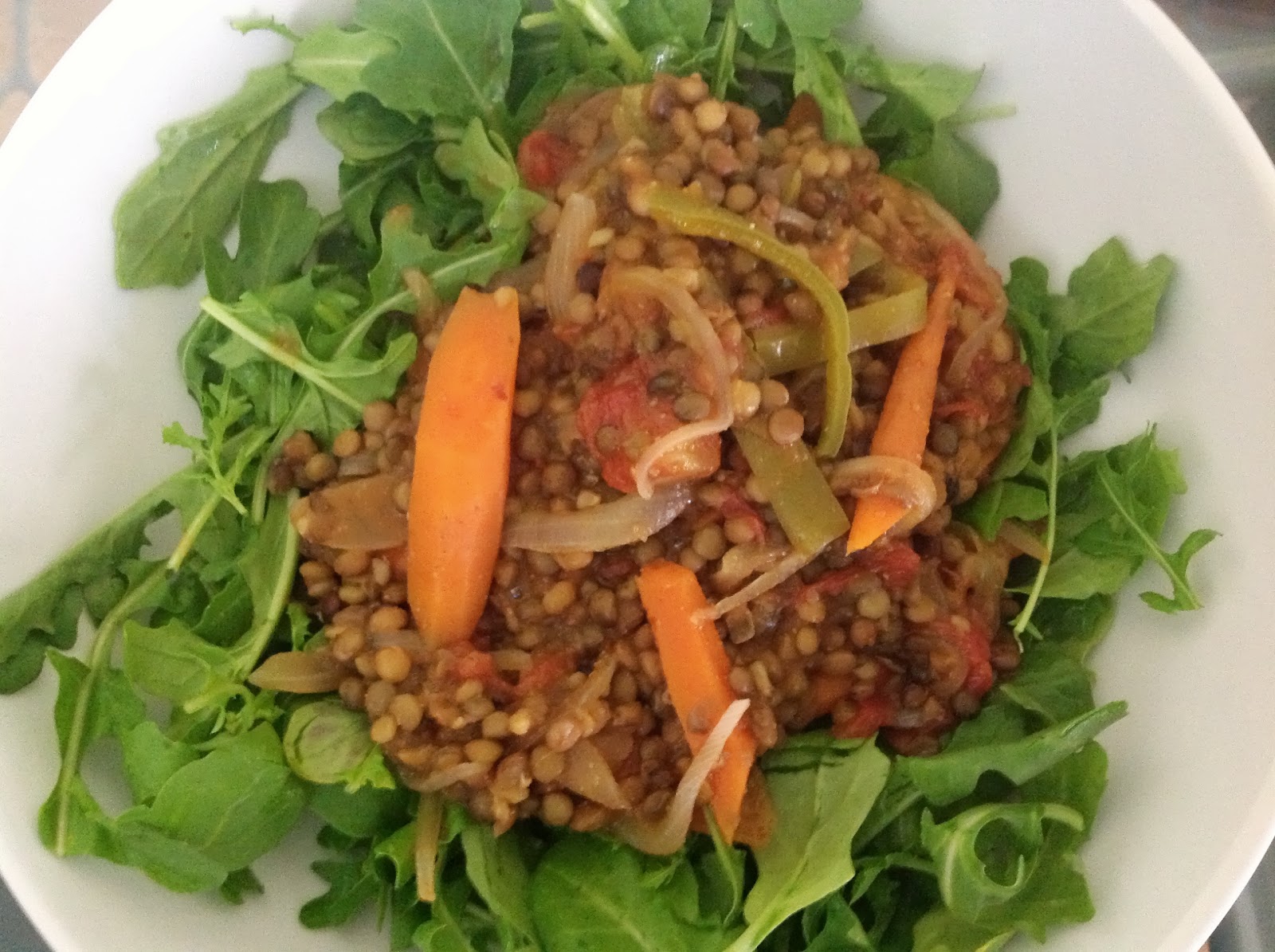
Lentil Stew, Sans the Meat

I've been making lentil stew with beef or lamb for years.  It's a delicious and nutritious family favorite.  One of my happiest discoveries since embarking on the VB6 plan is that my favorite lentil stew is every bit as good sans the meat!  Plus, it's packed with protein, and it's low in calories. 

I start with one white onion and one bell pepper, which I slice into thin strips and toss in a Dutch oven with a tablespoon of olive oil.  I let that cook, stirring frequently, until the onions and peppers are just tender.


Next, I add a bunch of sliced carrots (about 2 cups worth).  I like my carrots to be rather large in this recipe, and I always cut them at an angle because they look beautiful that way!  Saute that for a few more minutes.


Next I peel and slice two large, ripe tomatoes and sprinkle a little salt on them to bring out the sweetness, like so.  I toss those into the pot as well and let them cook for a few minutes.


Finally, I add about two cups of cooked lentils.  You can cook the lentils yourself ahead of time, following the package directions, or you can buy pre-cooked lentils.  (Trader Joe's has excellent pre-cooked baby lentils from France, which can be found in the refrigerator section of the store.  That's what I use when I'm pressed for time.)  Pour in about 1 cup of water or vegetable broth, and season with salt, pepper, and cumin until the flavors taste just right.  If you want a little heat, add some cayenne pepper as well.


I let everything cook together on a low heat until all the flavors meld and the liquid reduces-- this simmering process should continue for at least half an hour, but the longer the stew cooks, the better it tastes!  Serve hot on brown rice, or my favorite, fresh arugula!


Monday, May 27, 2013

Turkish Manti Deconstructed and Reconstructed

There is nothing vegan about Turkish Manti, a delicious meat-filled dumpling topped with yogurt and garlic, and drizzled with hot, bubbly, peppery butter.  One of the things I love about the VB6 plan is that it allows you to indulge in the non-vegan foods that you love and crave.  You can bet this dish will be hitting the dinner table after 6:00 pm.

Making manti is a labor of love.  True Turkish manti involves making and rolling out paper thin rounds of dough, cutting them into tiny little squares, and stuffing and folding them one by one.  It's a lot of work, and the few times I have made it, I've had the good fortune to have dear friends and family to help (Guler, Cheryl, Wendy, Meryem, Gloria, Lisa, Angela, and of course Asaf and Halil).  However, there are a lot of short-cut or deconstructed versions of manti, often called "yalanci" or "liar's" manti -- boiled shell or bowtie noodles tossed with cooked ground beef and onions and served with the traditional toppings.  Yalanci manti is delicious and a favorite in our home.  But sometimes I crave something more authentic, but without all the labor, and that's what I call Deconstructed and Reconstructed Manti.

You start with 1 lb. of quality ground beef, 1 cup finely chopped white onion, 1/4 cup finely chopped Italian flat leaf parsley, and salt and pepper.


Combine with your hands.  Next, start filling wonton wrappers with the beef mixture, like this.


As you fill the wontons, place them on a pan or cookie sheet lined with parchment or waxed paper.  You should have enough to fill all the wrappers in a package of 50.  Any leftover meat can be turned into little meatballs, like so.


Next, bring a large pot of water to a boil, and add a beef bullion cube.  In the meantime, mix together two cups of plain yogurt, and add two large cloves of crushed or grated garlic, salt, and a drizzle of olive oil.  Set aside. 


Boil the manti in small batches until they float to the top and the meat inside is completely cooked.  Place manti in a large serving bowl or individual serving bowls and top with the yogurt mixture.  Next comes the Pièce de résistance - the butter sauce.  Melt 1/4 cup of real butter in a pan, sprinkle in paprika, and bring it to a frothy orange bubble.  Drizzle this on top of the yogurt. 

Finally top with any or all of the following (I like all of them, whereas Asaf does not really care for any of them):  Fresh chopped mint (or dried mint), fresh chopped dill (or dried dill), sumak, and red pepper (the best is Turkish dried red pepper, Pul Biber).  Afiyet Olsun!